USDA vs FHA vs Conventional vs VA Loans: 2026 Comparison
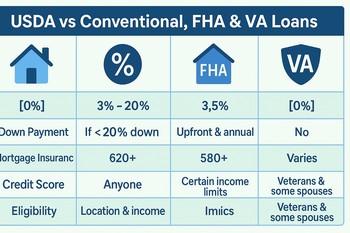 Choosing the right mortgage program is one of the most important financial decisions you will make. When comparing USDA vs FHA vs Conventional vs VA loans, you need to understand how each program differs in down payment requirements, mortgage insurance costs, credit requirements, and eligibility rules. This guide breaks down all four major loan programs so you can compare features and decide which one fits your situation, income level, and homeownership goals. Borrowers have several paths to homeownership, and each path has distinct advantages. USDA loans stand out for rural buyers who want zero down. FHA loans serve borrowers with limited savings or lower credit. Conventional loans reward strong credit with cancelable mortgage insurance. VA loans offer eligible service members no down payment and no monthly mortgage insurance.
Side‑by‑Side Comparison Table: USDA vs FHA vs Conventional vs VA
| Feature | USDA | FHA | Conventional | VA |
|---|---|---|---|---|
| Down Payment | 0% (100% financing) | 3.5% minimum (10% with scores 500–579) | 3% – 20% (varies) | 0% (100% financing) |
| Credit Score Requirement | No official minimum; 640 typical for automated (GUS) approval | 580 for 3.5% down; 500–579 with 10% down | 620 typical lender minimum; best pricing at 740+ | No VA minimum; lenders typically require 580–620 |
| Debt‑to‑Income Ratio | 29% housing / 41% total (higher with GUS approval) | 31% housing / 43% total (higher with automated approval) | Up to 45% (up to 50% with automated underwriting) | 41% guideline plus residual income test |
| Mortgage Insurance | 1% upfront guarantee fee + 0.35% annual fee (life of loan) | 1.75% upfront MIP + annual MIP (most borrowers 0.55%); life of loan with less than 10% down, 11 years with 10%+ down | PMI if down payment is less than 20%; cancelable at 20% equity, ends automatically at 22% | One‑time funding fee (1.25% – 3.3%); no monthly mortgage insurance |
| Interest Rates | Market‑based (typically competitive with FHA) | Market‑based (low note rates, but MIP raises total cost) | Market‑based (best pricing for high credit scores and larger down payments) | Market‑based (often the lowest available) |
| Property Location | USDA‑eligible rural and some suburban areas only | Any location (urban, suburban, rural) | Any location | Any location |
| Income Limits | Yes — 115% of area median income (varies by county and household size) | No income limits | No income limits | No income limits |
| Property Type | Primary residence only (single‑family, approved condos, new manufactured homes) | Primary residence (1–4 units, FHA‑approved condos, manufactured homes) | Primary residence, second home, or investment property | Primary residence only (1–4 units, VA‑approved condos) |
| Refinancing Options | Streamline, Streamlined‑Assist, and non‑streamlined (no cash‑out) | Streamline, rate‑and‑term, and cash‑out | Rate‑and‑term and cash‑out | IRRRL (streamline) and cash‑out |
| Seller Concessions | Up to 6% of the sales price | Up to 6% of the sales price | 3% (under 10% down), 6% (10–25% down), 9% (over 25% down); 2% on investment properties | Up to 4% in concessions; normal closing costs paid by the seller don't count toward the cap |
| Closing Cost Rules | No program‑specific cap; fees must be reasonable and customary | No program‑specific cap | No program‑specific cap | Lender's flat origination fee capped at 1%; some fees can't be charged to the veteran |
| Loan Limits | No set maximum on Guaranteed loans; limited by income and repayment ability | $541,287 floor to $1,249,125 ceiling (2026, one‑unit) | $832,750 baseline; up to $1,249,125 in high‑cost areas (2026); jumbo loans above | No limit with full entitlement; county limits apply with reduced entitlement |
| Borrower Eligibility | U.S. citizens, permanent residents, or qualified aliens; household income limits apply | U.S. citizens or permanent residents | U.S. citizens, permanent residents, and eligible non‑permanent residents | Eligible service members, veterans, and certain surviving spouses |
Loan limits shown are 2026 figures for one‑unit properties. Individual lenders may set stricter credit and debt‑to‑income requirements than the program minimums.
Detailed Program Breakdown
USDA Loans: Rural and Suburban Focus
USDA loans are designed to promote homeownership in rural America and qualifying suburban areas. The USDA Single Family Housing Guaranteed Loan Program, administered by USDA Rural Development, targets low‑ to moderate‑income borrowers buying in eligible areas. If you are a rural homebuyer checking USDA income limits or property eligibility requirements, this program offers significant financial advantages.
The biggest strengths are a zero down payment requirement and lower mortgage insurance costs than FHA. You pay a 1% upfront guarantee fee and a 0.35% annual fee, compared with FHA's 1.75% upfront and typical 0.55% annual MIP. The upfront guarantee fee can be financed into the loan, and interest rates are typically competitive with or below FHA. Seller‑paid closing costs can cover up to 6% of the purchase price.
The biggest limitation is location. The property must be in an eligible rural area, and household income limits apply by county. The 0.35% annual fee lasts for the life of the loan, and the loan is restricted to primary residences only. Most lenders want a 640 credit score for automated approval. Processing times may run longer, around 45 to 60 days, because USDA reviews the file before issuing the guarantee.
FHA Loans: Accessible to First‑Time Buyers
FHA loans, insured by the Federal Housing Administration, were created to make homeownership achievable for borrowers with limited savings and moderate credit. FHA loans allow down payments as low as 3.5% with a 580 credit score, making them popular with first‑time homebuyers in any location. If you are comparing an FHA loan vs USDA loan, the FHA option works nationwide, while USDA loans are limited to eligible rural and suburban areas.
FHA offers the most flexible credit standards of the four programs. A 580 score qualifies for 3.5% down, and scores from 500 to 579 are possible with 10% down. You can buy in any location, finance 1–4 unit homes if you live in one unit, and negotiate seller concessions up to 6%. Streamline refinance options require minimal documentation.
The trade‑off is mortgage insurance. The annual MIP lasts for the life of the loan with less than 10% down. With 10% or more down, it ends after 11 years. There is also an upfront MIP of 1.75% of the loan amount. For borrowers with strong credit, MIP often makes the total cost higher than a conventional loan, and FHA has strict property condition and appraisal requirements.
Conventional Loans: The Traditional Standard
Conventional loans are mortgages not backed by any government agency. Most are sold to Fannie Mae and Freddie Mac and follow their guidelines. Conventional loans are the most common mortgage type in the United States and offer the best pricing for well‑qualified borrowers. When comparing a USDA loan vs conventional mortgage, conventional loans offer flexibility and cancelable mortgage insurance, but generally reward stronger credit and larger down payments.
Borrowers with strong credit and larger down payments get competitive rates. PMI can be canceled at 20% equity and ends automatically at 22%. With 20% down, there is no mortgage insurance at all. Conventional loans are also available for investment properties and second homes, with flexible loan terms and no restrictions on property location or borrower income.
The main limitations are the down payment and credit requirements. You need 20% down to avoid PMI, though the minimum down payment is 3%. Most lenders require a 620 credit score, and pricing and PMI costs rise sharply at lower scores. Debt‑to‑income limits are tighter than FHA's, generally 45%, or up to 50% with automated approval.
VA Loans: Exclusive Military Benefit
VA loans are guaranteed by the Department of Veterans Affairs and rank among the most powerful homeownership programs available. Eligibility is based on qualifying military service, whether active duty, Reserve, or National Guard, or surviving spouse status. If you are comparing USDA vs VA loans, the VA program generally offers better terms for eligible borrowers.
VA loans offer zero down payment and no monthly mortgage insurance. A one‑time funding fee applies instead, which can be financed or paid by the seller as a concession. Interest rates are often the lowest available, and there are no prepayment penalties. You can reuse your benefit multiple times, and a residual income test alongside the DTI guideline can increase your borrowing power.
Eligibility is restricted to qualified service members, veterans, and certain surviving spouses, and you must obtain a Certificate of Eligibility. The funding fee ranges from 1.25% to 3.3% of the loan amount unless you receive VA disability compensation or qualify for another exemption. The VA appraisal must meet Minimum Property Requirements, which can slow processing.
Which Loan Should You Choose?
Choose a USDA loan if your household income is at or below county limits and the property sits in an eligible rural or suburban area. USDA works well when you want zero down with lower mortgage insurance costs than FHA, and your credit score is around 640 or higher. First‑time and repeat buyers can qualify as long as you do not currently own an adequate home.
Choose an FHA loan if you have limited funds for a down payment, at least 3.5%, and your credit score is 580 or higher. FHA also works with scores from 500 to 579 if you can put 10% down. It is a good fit when you want to buy in any location and need more flexible credit or debt‑to‑income standards from a well‑established nationwide program.
Choose a conventional loan if you have strong credit, ideally 740 or higher for the best pricing, and can put 3% to 20% down. Conventional loans make sense when you want mortgage insurance you can cancel, or when you plan to buy an investment property or second home. They are also the right choice if your income is above USDA limits or the property is not in an eligible area.
Choose a VA loan if you are an eligible service member, veteran, or surviving spouse. VA loans give you zero down payment, no monthly mortgage insurance, and some of the lowest interest rates available. They also work when your income is above USDA limits or you are buying outside an eligible area, and you value the additional VA protections and benefits.
Key Takeaway: USDA vs FHA vs Conventional vs VA loans — USDA loans combine zero down payment with lower mortgage insurance costs than FHA for rural and suburban buyers within income limits. FHA loans suit buyers with lower credit scores or limited savings in any location. Conventional loans reward strong credit with competitive pricing and cancelable PMI. VA loans are unmatched for eligible borrowers, with no down payment and no monthly mortgage insurance. To determine which loan fits your situation, consider your down payment funds, credit score, income level, property location, and long‑term homeownership goals.
Frequently Asked Questions About Loan Comparisons
Can I use both USDA and VA benefits at the same time?
No, you cannot combine both programs on one loan. If you qualify for both, VA usually comes out ahead because it has no monthly mortgage insurance and no income limits. You also avoid the funding fee if you receive VA disability compensation. Compare quotes for both before deciding.
Which program has the fastest closing timeline?
Conventional loans generally close fastest, in 21 to 30 days, because no government agency reviews the file. USDA loans often take 45 to 60 days because the file goes to USDA for a final guarantee review after the lender approves it. FHA and VA loans typically fall in the 30 to 45 day range, depending on the lender.
What happens if I refinance from one program to another?
You can refinance from any loan type into any other program you qualify for. For example, you could start with an FHA loan and refinance to a conventional loan once you have 20% equity to drop mortgage insurance. USDA, FHA, and VA borrowers can also use streamline refinances within their programs for lower costs and faster approval.
Do I have to live in the home to qualify for these loans?
Yes for USDA, FHA, and VA. All three require the home to be your primary residence, though FHA and VA allow 2–4 unit properties if you live in one unit. Conventional loans are the only one of the four that finance second homes and investment properties.
Which program is best for low credit scores?
FHA is the most forgiving, with a 580 score qualifying for 3.5% down and scores from 500 to 579 possible with 10% down. VA has no official minimum, and many lenders go down to 580 to 620. USDA also has no official minimum, but most lenders want 640 for automated approval. Conventional lenders usually look for about 620, and PMI costs rise at lower scores.
USDA vs FHA vs Conventional vs VA loans — each program serves a different borrower profile. Use this comparison to match your down payment, credit, income, and location with the mortgage that fits you best.
Connect With Us
Please share – it really helps