USDA Loans vs Conventional Loans: Complete 2026 Comparison
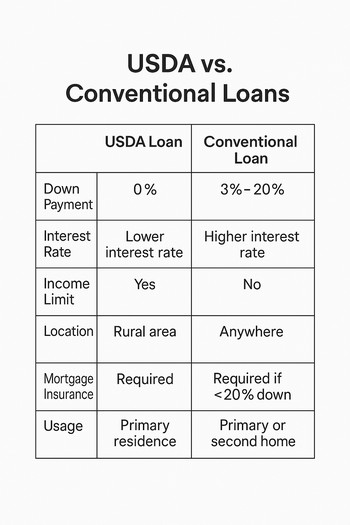 Choosing between a USDA loan and a conventional mortgage is one of the most important decisions when buying a home. Both USDA loans and conventional mortgages offer distinct advantages depending on your financial situation, credit history, and where you plan to live. Understanding the key differences between these two loan types will help you make an informed decision and secure the best mortgage option for your needs.
The U.S. Department of Agriculture backs the USDA loan program to promote homeownership in rural and suburban areas, supporting communities that lack access to affordable housing. Conventional loans, offered by private lenders and following Fannie Mae and Freddie Mac guidelines, provide flexibility for buyers in any location with strong credit profiles. This comprehensive guide compares USDA vs conventional loans across all critical factors including down payments, interest rates, credit requirements, insurance costs, and property eligibility.
What Is a USDA Loan?
A USDA loan is a government-backed mortgage available to low- and moderate-income homebuyers purchasing in USDA-eligible rural areas. These loans are designed to make homeownership accessible to borrowers who may not have significant savings for a down payment or have limited credit history.
The two main USDA loan programs include:
-
USDA Guaranteed Loan Program: Issued by approved lenders and backed by the USDA guarantee. This is the most common USDA loan type for residential purchases.
-
Section 502 Direct Loan Program: Funded directly by the USDA for very low-income households, offering even more flexible terms than guaranteed loans.
Unlike conventional loans, USDA mortgages come with zero down payment requirements, typically lower interest rates, and reduced mortgage insurance costs compared to private mortgage insurance on conventional loans.
USDA loans are particularly attractive to first-time homebuyers and individuals who may not have access to traditional financing due to income limitations or limited savings. The program is designed to help families achieve sustainable homeownership without the burden of large upfront costs.
Key Benefits of USDA Loans
-
0% down payment: No need for a large upfront investment, making homeownership accessible to those with limited savings.
-
Competitive interest rates: USDA loans often offer lower interest rates than conventional loans, resulting in lower monthly payments.
-
Reduced mortgage insurance: USDA charges a 1% upfront guarantee fee and 0.35% annual fee—usually less than private mortgage insurance (PMI) on conventional loans.
-
No cash reserves required: Many USDA lenders do not require borrowers to maintain reserve funds after closing.
-
Financing for repairs: Eligible home repairs or improvements can be rolled into the loan amount through Section 504 programs.
-
Assumable loans: USDA loans can be transferred to a new buyer, potentially locking in favorable terms for future owners.
-
Flexible credit guidelines: USDA loans offer more flexible credit requirements than conventional options, accepting borrowers with limited or no credit history.
Additionally, USDA loans support energy-efficient home upgrades that reduce long-term living costs, and some programs allow closing costs to be included in the loan amount, easing the financial burden on homebuyers.
USDA Loan Eligibility Requirements
To qualify for a USDA loan, applicants must meet specific criteria:
-
Location: The home must be in a USDA-designated rural area. Properties in urban or densely populated areas typically do not qualify.
-
Income limits: Household income must fall below 115% of the area median income, which varies by county and family size.
-
Primary residence: The property must be a primary residence—not a second home, investment property, or vacation home.
-
Credit score: While there's no hard minimum, lenders typically look for a credit score of 640 or higher, though some accept lower scores with compensating factors.
-
Debt-to-income ratio: Borrowers must meet specific debt-to-income ratio requirements, typically a front-end ratio of 29% and back-end ratio of 41%.
Applicants must also demonstrate the ability to repay the loan through steady employment, manageable debt levels, and sufficient assets. Income documentation and job history are reviewed closely to ensure long-term affordability and repayment capacity.
What Is a Conventional Loan?
A conventional loan is a mortgage not insured or guaranteed by the federal government. It's offered by private lenders such as banks, credit unions, and mortgage companies, and follows underwriting guidelines set by Fannie Mae and Freddie Mac.
Conventional loans are often preferred by buyers with strong credit scores, stable income, and sufficient savings for a down payment. These loans provide greater flexibility than government-backed programs, allowing borrowers to purchase properties in any location and use the funds for second homes or investment properties.
Types of Conventional Loans
-
Fixed-rate mortgages: Monthly payments remain constant throughout the entire loan term, providing predictable budgeting.
-
Adjustable-rate mortgages (ARMs): Interest rates are fixed for an initial period (typically 3-10 years), then adjust periodically based on market conditions.
-
Conforming loans: Follow Fannie Mae or Freddie Mac guidelines and have loan limits (currently $806,500 in most areas for 2026).
-
Non-conforming/Jumbo loans: Exceed conforming loan limits and are often used for high-value properties or unique financial situations.
-
Portfolio loans: Retained by the lender rather than sold on the secondary market, offering custom terms for unique borrower situations.
Conventional loans may also include renovation loans for fixer-upper properties, interest-only options for certain investors, and various other structures tailored to specific borrower needs and financial goals.
Advantages and Disadvantages of Conventional Loans
Conventional Loan Advantages:
-
Available in all locations nationwide—no geographic restrictions like USDA rural requirements.
-
Flexible property types: Can be used for second homes, rental properties, and investment real estate.
-
Customizable loan terms: Common options include 10-, 15-, 20-, and 30-year terms.
-
No upfront guarantee fee: Unlike USDA loans, conventional mortgages don't charge an initial upfront fee.
-
PMI removal option: Private mortgage insurance can be canceled once borrowers reach 20% equity in the home.
-
Wider lender selection: More lenders offer conventional loans, providing greater competition and rate options.
-
Faster closing timeline: Conventional loans typically close in 30-45 days with fewer regulatory delays.
Conventional Loan Disadvantages:
-
Down payment required: Typically 3% to 20% depending on credit score and lender requirements.
-
Private mortgage insurance (PMI): Required if down payment is less than 20%, increasing monthly costs.
-
Stricter credit standards: Most lenders require credit scores above 680 for favorable rates.
-
Higher rates for lower credit scores: Borrowers with scores below 700 may face significantly higher interest rates.
-
Cash reserves required: Many lenders require proof of liquid assets or cash reserves equal to 2-6 months of mortgage payments.
-
More sensitive to market rate changes: Interest rates can fluctuate significantly based on economic conditions.
FHA Loans: An Alternative Option
While comparing USDA and conventional loans, it's worth noting that FHA loans provide a middle ground between the two. Backed by the Federal Housing Administration, FHA mortgages are designed for borrowers with lower credit scores or limited savings.
FHA loans require as little as 3.5% down with a credit score of 580 or higher, making them accessible to borrowers who don't qualify for conventional mortgages. However, FHA loans require mortgage insurance for the life of the loan, regardless of down payment amount. These loans are available in all geographic locations and offer more flexible credit requirements than conventional loans, though they're typically more restrictive than USDA programs.
Key Differences: USDA vs Conventional Loans
When comparing USDA and conventional loans, understanding the following differences is critical to choosing the right mortgage:
1. Geographic Location Requirements
USDA loan: Restricted to USDA-eligible rural and suburban areas as determined by the U.S. Department of Agriculture. Property location lookup tools are available on the USDA website.
Conventional loan: Available nationwide with no geographic restrictions. You can purchase property anywhere in the United States.
Impact: If your desired home is in an urban area or doesn't qualify as rural, a conventional loan is your only option. Check USDA area eligibility before applying.
2. Down Payment Requirements
USDA loan: Zero down payment required. You can finance 100% of the home's purchase price.
Conventional loan: Requires 3% to 20% down payment, depending on credit score and lender policy.
Impact: USDA's zero-down feature makes homeownership accessible to borrowers with limited savings. Conventional loans requiring down payments make them better suited for buyers with accumulated capital.
3. Mortgage Insurance Costs
USDA loan: Charges a 1% upfront guarantee fee (financed into loan) and 0.35% annual fee, typically costing $3,500-$5,000 upfront on a $350,000-$500,000 loan.
Conventional loan: Requires PMI if less than 20% down (typically 0.3%-1.86% annually). PMI can be removed once you reach 20% equity.
Impact: Over time, conventional PMI may become cheaper than USDA's ongoing annual fees. Use our USDA loan calculator to compare long-term costs.
4. Credit Score Requirements
USDA loan: Most lenders look for 640+ credit score, though some accept lower scores with compensating factors or alternative credit documentation.
Conventional loan: Typically requires 680 or higher for competitive rates; scores below 680 face higher rates or stricter terms.
Impact: USDA's more flexible credit requirements make it ideal for borrowers with limited credit history or past financial challenges.
5. Loan Limits
USDA loan: No official maximum loan limit, but the total loan amount is capped based on borrower income and debt-to-income ratios.
Conventional loan: Conforming loans are subject to $806,500 limit in most U.S. areas (2026). Jumbo loans exceed this limit but have stricter requirements.
Impact: High-cost property markets may require conventional or jumbo loans. USDA income limits may restrict loan amounts for high-income borrowers.
6. Eligible Property Types
USDA loan: Primary residences only in eligible rural areas. Cannot be used for second homes, investment properties, or vacation homes.
Conventional loan: Can finance primary residences, second homes, rental properties, investment real estate, and vacation properties.
Impact: Investors and buyers with multiple properties must use conventional financing. USDA is strictly for primary residence purchases.
7. Property Condition and Appraisal Standards
USDA loan: Property must meet strict safety and livability standards. USDA appraisers have specific requirements; fixer-uppers may be rejected.
Conventional loan: More flexible on property condition. Appraisers follow standard valuation methods with fewer government-mandated restrictions.
Impact: If buying a fixer-upper or unique property, conventional loans offer more flexibility. USDA's strict standards protect borrowers but limit options.
8. Processing Time and Closing Timeline
USDA loan: May take 45-60+ days due to government property eligibility verification and additional underwriting steps.
Conventional loan: Typically closes in 30-45 days with fewer regulatory requirements and faster underwriting.
Impact: In competitive housing markets, conventional loans' faster closings provide an advantage. USDA's longer timeline allows more thorough property review.
Complete Pros and Cons Summary
USDA Loan Benefits and Drawbacks
USDA Loan Pros:
- Zero down payment required
- Competitive interest rates often lower than conventional
- Easier qualification for low-to-moderate income borrowers
- Ideal for first-time homebuyers with limited savings
- Flexible credit requirements and guidelines
- Can finance closing costs into the loan
- Supports rural development and homeownership goals
- Assumable loans benefit future buyers
USDA Loan Cons:
- Limited to USDA-eligible rural and suburban areas
- Strict income limits restrict higher-earning borrowers
- Annual guarantee fee (0.35%) for life of loan
- Primary residence requirement—no investment properties
- Longer closing timelines due to government involvement
- Fewer lenders offer USDA loans compared to conventional
- Stricter property condition requirements
- More documentation and verification requirements
Conventional Loan Benefits and Drawbacks
Conventional Loan Pros:
- Available in all locations nationwide
- Multiple property types allowed (primary, second, investment)
- PMI can be canceled at 20% equity
- Greater lender variety and competition
- Suitable for high-cost and urban real estate markets
- Customizable loan structures and terms
- Faster closing timelines (30-45 days typical)
- No upfront guarantee or insurance fee
Conventional Loan Cons:
- Requires down payment (3-20%)
- Stricter credit score requirements (680+)
- Higher interest rates for lower-credit borrowers
- PMI costs can be substantial with low down payments
- More sensitive to economic rate fluctuations
- Cash reserve requirements may apply
- Stricter income and debt documentation
- Less flexible for borrowers with limited credit history
Which Loan Is Right for You?
Choose a USDA Loan if You Meet These Criteria:
- Want to buy in a USDA-eligible rural or suburban area
- Need a zero-down mortgage option
- Household income falls within USDA limits for your county
- Plan to live in the home as your primary residence
- Want to minimize upfront out-of-pocket costs
- Have moderate credit (640+) and steady employment
- Prefer government-backed loan protections and support
- Are a first-time homebuyer with limited savings
Choose a Conventional Loan if You Meet These Criteria:
- Are buying outside USDA-eligible rural zones
- Want to purchase a second home or investment property
- Have strong credit (680+) and substantial savings
- Prefer avoiding government restrictions and requirements
- Are buying in a high-cost or competitive real estate market
- Want the option to remove PMI at 20% equity
- Value faster closing timelines
- Want maximum flexibility in lender and loan product selection
The right choice depends on your unique financial situation, property location, credit profile, and homeownership goals. Consider consulting with a USDA-approved lender who can discuss both options and help you select the best mortgage for your needs.
Frequently Asked Questions About USDA vs Conventional Loans
What is the main difference between USDA and conventional loans?
The primary differences are down payment requirements, geographic restrictions, and loan backing. USDA loans require zero down payment and are limited to rural areas, backed by the U.S. Department of Agriculture. Conventional loans require 3-20% down, have no geographic restrictions, and are offered by private lenders. USDA loans target low-to-moderate income borrowers, while conventional loans require stronger credit and financial profiles.
Can I use a USDA loan to buy a second home?
No. USDA loans are exclusively for primary residences. You cannot use a USDA loan to purchase second homes, investment properties, or vacation homes. The property must be your main dwelling where you live full-time. Conventional loans, however, can be used for second homes, rental properties, and investment purposes, offering greater flexibility for multiple property purchases.
What credit score do I need for a USDA loan versus a conventional loan?
USDA loans typically require a credit score of 640 or higher, though some lenders accept lower scores with compensating factors or alternative credit documentation. Conventional loans usually require a credit score of 680 or higher for competitive rates, with scores below 680 facing higher interest rates. USDA's more flexible credit requirements make it easier for borrowers with limited credit history to qualify.
Which loan has lower mortgage insurance costs?
USDA loans charge a 1% upfront guarantee fee (typically $3,500-$5,000) and 0.35% annual fee. Conventional loans require PMI (private mortgage insurance) if you put down less than 20%, typically ranging from 0.3%-1.86% annually. Over the loan's lifetime, conventional PMI may become cheaper than USDA's annual fees, depending on the loan amount, home value, and how quickly you build equity. Use our mortgage calculator to compare long-term costs.
How long does it take to close a USDA loan versus a conventional loan?
Conventional loans typically close faster, usually within 30-45 days, because they involve fewer government regulations and faster underwriting. USDA loans may take longer due to government involvement and property eligibility verification, sometimes extending to 45-60 days or more, depending on the lender and application complexity. Faster conventional closings can be advantageous in competitive housing markets.
Are USDA loans assumable like conventional loans?
Yes, both USDA and conventional loans can be assumable, meaning a future buyer can take over the loan from the original borrower. For USDA loans, the new buyer must still meet income and property eligibility requirements. Assumable loans are attractive to future purchasers because they may lock in a lower interest rate than current market rates, providing long-term savings for the new owner.
What happens if my property doesn't qualify as USDA-eligible?
If your desired property is not in a USDA-eligible area, you cannot use a USDA loan and must pursue conventional financing. Check USDA area eligibility online before making an offer. You may also consider FHA loans as an alternative if you don't qualify for conventional financing.
Can I refinance a USDA loan into a conventional loan?
Yes, you can refinance a USDA loan to a conventional mortgage if your financial situation improves. This may make sense if you've built significant equity, improved your credit score, or want to eliminate USDA annual fees. Learn more about USDA loan refinancing options to determine if refinancing is advantageous for your situation.
Additional Mortgage Loan Options: FHA and VA Loans
FHA Loan Overview
FHA loans, backed by the Federal Housing Administration, provide another alternative for homebuyers who don't qualify for conventional mortgages. These loans are designed for low-to-moderate income borrowers and those with limited credit history.
- Low down payment: As little as 3.5% with a credit score of 580 or higher
- Flexible credit requirements: Acceptable for borrowers with credit scores in the 500s
- Mortgage insurance required: Upfront and annual insurance required for all FHA loans, regardless of down payment
- Assumable loans: Can be transferred to qualified future buyers
- Nationwide availability: Available in all geographic locations
- Higher debt-to-income limits: Allows up to 50% back-end DTI in some cases
FHA loans provide a middle ground—offering easier qualification than conventional loans but without the location restrictions of USDA loans. They're especially helpful for first-time buyers with limited credit history or past financial setbacks.
VA Loan Overview
If you're a veteran, active-duty service member, or eligible surviving spouse, a VA loan could be the best deal of all. These loans offer exceptional benefits and are often the most affordable mortgage option available.
- Zero down payment: 0% down required
- No mortgage insurance: VA loans don't require PMI, saving thousands annually
- Competitive interest rates: Often among the lowest available
- Limited closing costs: Seller typically pays most closing costs
- No loan limits: No maximum loan amount in most areas
- Foreclosure avoidance: Includes assistance programs to help prevent foreclosure
- Refinance flexibility: Can refinance VA or non-VA loans using VA programs
VA loans frequently offer the lowest monthly mortgage payment of all mortgage types. Veterans should always explore VA eligibility before pursuing other loan programs.
Final Recommendations: USDA vs Conventional Loans
Choosing between a USDA loan and a conventional mortgage is a significant financial decision that requires careful consideration of your unique circumstances. USDA loans are ideal for rural, income-qualified buyers with limited savings who plan to live in their home full-time. Conventional loans suit buyers with stronger financials, those seeking flexibility in location and property type, or those purchasing in high-cost markets.
To make the best decision:
- Check your USDA income eligibility and property eligibility
- Review your credit score and financial profile
- Compare interest rates and long-term costs for both options
- Consider your timeline and preferred closing speed
- Evaluate your future property plans (second homes, investments, etc.)
- Consult with a trusted USDA-approved lender who understands both programs
No matter which loan you choose, working with an experienced loan officer will ensure you secure the best mortgage for your needs and achieve your homeownership goals with confidence. Take time to evaluate all available programs carefully and select the path that aligns with your financial future and personal circumstances.
Connect With Us
Please share – it really helps