USDA Loan Flood Insurance Requirements for Homeowners
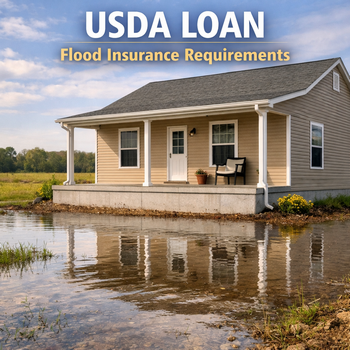 Homeowners with USDA flood insurance requirements must understand how federal flood insurance works and why
lenders mandate coverage on properties in high-risk areas. If you're buying a home with a USDA loan, your lender will require proof of adequate flood insurance before you can close on the property. This protection secures both you and the lender from catastrophic losses due to flooding.
Homeowners with USDA flood insurance requirements must understand how federal flood insurance works and why
lenders mandate coverage on properties in high-risk areas. If you're buying a home with a USDA loan, your lender will require proof of adequate flood insurance before you can close on the property. This protection secures both you and the lender from catastrophic losses due to flooding.
The National Flood Insurance Program (NFIP) is the primary source for homeowners who need flood coverage. Unlike standard homeowners insurance, flood insurance policies specifically cover damage from flooding events. Understanding USDA flood insurance requirements helps you manage the process and avert delays in your home purchase.
When Flood Insurance Is Required for USDA Loans
USDA lenders require flood insurance on all properties located in special flood hazard areas, also called high-risk flood zones. The Federal Emergency Management Agency (FEMA) creates and maintains flood maps that identify these dangerous areas. Your property is located in a high-risk zone if it falls within the 100-year floodplain, which has a 1 percent annual chance of flooding.
If your property is located outside the high-risk zone, flood insurance may still be optional, but many homeowners purchase it anyway for added peace of mind. Even properties in low-to-moderate risk areas can experience flood damage from unanticipated weather events or drainage failures. Your lender may also recommend coverage if the property has a history of water issues.
- Properties in special flood hazard areas require mandatory coverage
- FEMA flood maps determine your property's risk category
- High-risk flood zones trigger automatic lender requirements
- Low-risk properties may have optional coverage available
- Borrowers should verify their property's flood status before closing
Understanding the National Flood Insurance Program and NFIP Policies
The National Flood Insurance Program was created by Congress to provide insurance coverage for homeowners who cannot obtain private flood insurance. NFIP policies are backed by the federal government and cover up to $250,000 for the home structure and $100,000 for personal property. Most NFIP policies include a deductible ranging from $1,000 to $30,000, depending on your coverage choice.
A USDA homeowner purchasing through an NFIP policy must understand the coverage limits and deductibles. Your mortgage lender will verify that your insurance policy meets their minimum requirements before approving the loan. The coverage amount must equal at least the property's replacement value or the mortgage amount, whichever is less.
NFIP policies have a 30-day waiting period before coverage takes effect, except for properties being purchased or refinanced, which are covered immediately. If you're closing on a new USDA loan, make sure your policy is active before the closing date. Your lender may delay closing until proof of coverage is provided.
- NFIP is the largest flood insurance provider in the United States
- Coverage limits reach $250,000 for structure and $100,000 for contents
- Standard deductibles range from $1,000 to $30,000
- 30-day waiting period applies to new policies (exceptions for purchases)
- Federal backing ensures policy stability and claim payment
USDA Flood Insurance Deductible Requirements and Coverage Options
Your USDA flood insurance deductible requirements depend on the risk level of your property and the type of coverage you choose. Higher deductibles lower your annual premium, while lower deductibles mean higher out-of-pocket costs when a claim occurs. Most borrowers select deductibles between $1,000 and $10,000 to balance cost-effectiveness with reasonable out-of-pocket risk.
The deductible you select applies to each separate flood event. If your home floods twice in one year, you pay the deductible amount for each incident. Your lender could have specific deductible requirements, though most allow flexibility within NFIP guidelines. Always confirm your lender's deductible preferences before purchasing your policy.
USDA flood zone guidelines help determine which coverage option fits your property. The Homeowner Flood Insurance Affordability Act of 2013 created multiple policy tiers to serve different risk levels and budgets. Standard policies cover the full replacement value, while subsidized policies may offer lower premiums for certain property types.
| Deductible Amount | Coverage Scope | Typical Premium Range |
|---|---|---|
| $1,000 | Full replacement value coverage | $400–$800 annually |
| $5,000 | Standard NFIP coverage | $250–$500 annually |
| $10,000 | High-deductible option | $150–$350 annually |
| $30,000 | Maximum deductible allowed | Under $150 annually |
Private Flood Insurance and Alternative Options
Private flood insurance has grown in popularity as homeowners seek alternatives to NFIP. Private insurance companies now offer competitive rates and broader coverage options than traditional government policies. A federally regulated or insured lender may accept private flood insurance if it meets the requirements of the National Flood Insurance Act.
Private policies frequently include lower deductibles, higher coverage limits, and faster claims processing relative to NFIP. However, private carriers are not available in all markets, and rates change significantly by property location and risk profile. Your insurance agent can compare NFIP and private options to help you find the best fit for your situation.
A federally regulated or insured lender may require that your private policy maintain the same replacement value standards as NFIP coverage. Before selecting a private carrier, confirm that your lender will accept the policy and that the insurer is financially stable and licensed in your state.
- Private carriers offer competitive rates in many markets
- Coverage options may be broader than standard NFIP policies
- Claims processing is often faster with private insurers
- Not every region has access to private flood insurance options
- Lender approval is required before purchasing a private policy
How Mortgage Lenders Handle Flood Insurance Requirements
Your mortgage lender acts as the enforcer of flood insurance compliance throughout your loan term. Before closing, the lender verifies that your property is located in a flood zone and confirms that adequate coverage is in place. If your property sits in a special flood hazard area, the lender will not approve the loan without proof of insurance.
The lender's loss payee status appears on your insurance policy, meaning the lender receives claim payments if the property is damaged. This protects the lender's investment in the property and ensures that flood-damage repairs are funded. Your insurance requirements remain in place for the entire duration of your mortgage, even if flood risk maps change.
If you allow your flood insurance to lapse, the lender may purchase a force-placed policy on your behalf and add the premium to your mortgage payment. Force-placed insurance is significantly more expensive than policies you purchase independently. The lender will charge you for premiums, interest, and administrative fees, rendering it financially advantageous to maintain continuous coverage.
- Lenders verify flood insurance before approving the mortgage
- Loss payee status protects the lender's financial interest
- Insurance must remain active throughout the loan term
- Lapsed coverage results in force-placed policies and higher costs
- Borrowers are responsible for policy payments and renewals
Flood Insurance Costs and Finding Lower Rates
Flood insurance premiums depend on a number of factors including property location, risk zone, coverage amount, and deductible selection. Properties in high-risk flood zones typically pay $400 to $3,000 annually, while moderate-risk properties may pay $100 to $400 per year. Understanding what drives your rates helps you find lower rates and manage flood insurance costs.
The deductible you select has the most direct impact on your annual premium. Raising your deductible from $1,000 to $10,000 can reduce premiums by 30 to 50 percent. Elevation certificates, which document your home's height above the base flood elevation, can also lower rates significantly if your property sits above the expected flood level.
Shopping with multiple insurance companies is essential for finding lower rates. Each insurer uses different risk models, and premium quotes can vary by thousands of dollars for the same property. An insurance agent can access multiple carriers and help you compare quotes side by side. Some states offer NFIP discounts for homes with mitigation improvements like raised utilities or flood vents.
| Risk Category | Average Annual Premium | Deductible Assumption |
|---|---|---|
| High-risk (100-year zone) | $800–$2,500 | $5,000 |
| Moderate-risk (500-year zone) | $200–$600 | $5,000 |
| Low-risk (outside mapped zones) | $50–$200 | $5,000 |
Steps to Purchase Flood Insurance for Your USDA Loan
Purchasing flood insurance for your USDA homeowner loan entails several steps. First, obtain a flood map from FEMA to confirm whether your property is located in a flood zone. You can check the FEMA flood map database online or contact your local emergency management office for verification.
Second, contact NFIP-authorized agents or private insurance companies to request quotes. Provide your property address and the mortgage amount to obtain precise pricing. Review each quote carefully, paying attention to coverage limits, deductibles, and any exceptions or limitations.
Third, select a policy and purchase flood insurance at least 30 days before your closing date. Provide proof of coverage to your lender so the loan process can go ahead without delay. Keep your policy active by paying premiums on time and renewing it each year before it expires.
- Obtain FEMA flood map verification for your property address
- Ask for quotes from multiple NFIP agents and private carriers
- Compare coverage limits, deductibles, and annual premiums
- Purchase insurance well before your closing date
- Provide proof of coverage to your USDA mortgage lender
Frequently Asked Questions About USDA Flood Insurance
What happens if I don't purchase flood insurance when my lender requires it?
Your lender will not approve your USDA loan without proof of flood insurance on properties located in high-risk areas. If you refuse to purchase coverage, the loan will not close. If you allow coverage to lapse after closing, the lender will purchase force-placed insurance and charge you significantly higher premiums.
Can I cancel my flood insurance once I pay off my mortgage?
Yes, you can cancel flood insurance after your mortgage is paid in full, even if your property continues in a flood zone. However, the 30-day waiting period applies if you ever need to purchase flood insurance again. Most homeowners maintain flood insurance indefinitely to protect their investment, even after the mortgage is satisfied.
Does my homeowners insurance cover flood damage?
Standard homeowners insurance policies specifically exclude flood damage. You must purchase a separate flood insurance policy through NFIP or a private carrier to cover losses from flooding events. Your homeowners insurance agent can help coordinate both policies and ensure there are no coverage gaps.
How do I lower my flood insurance premium?
You are able to lower your premium by increasing your deductible, obtaining an elevation certificate, making mitigation improvements, or shopping with various insurers. Raising your deductible from $1,000 to $10,000 typically reduces premiums by 30 to 50 percent. Mitigation improvements, such as raised utilities or flood vents, may qualify you for discounts.
What is the difference between the 100-year flood zone and the 500-year flood zone?
The 100-year floodplain has a 1 percent annual chance of flooding, while the 500-year floodplain has a 0.2 percent annual chance. Properties in the 100-year zone face significantly higher flood risk and mandatory insurance requirements. Properties in the 500-year zone may have optional insurance depending on your lender's specific requirements.
Connect With Us
Please share – it really helps